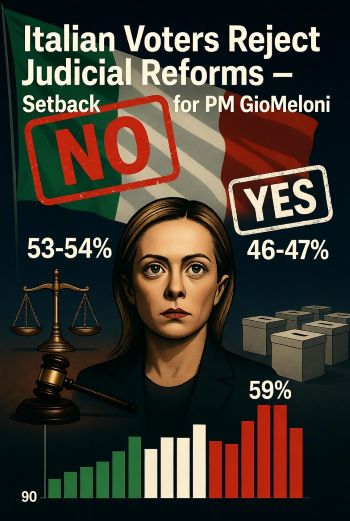
On March 22–23, 2026, Italian voters rejected a constitutional referendum on judicial reforms proposed by Giorgia Meloni’s (Italy’s current Prime Minister). The “No” camp won with approximately 54% of the vote, while the government-backed “Yes” received about 46–47%. Turnout was higher than expected, at around 59% (roughly 28.6 million total votes cast).
Key Elements of the Proposed Reform
The reform aimed to overhaul aspects of Italy’s judiciary, which has long been criticized for being slow and inefficient. Main proposals included:
- Separating the careers of judges and public prosecutors (currently, they share a unified path and training).
- Creating distinct governing bodies (splitting the single CSM — Consiglio Superiore della Magistratura) for judges and prosecutors.
- Establishing a new, independent disciplinary court (Alta Corte Disciplinare) for handling misconduct cases.
The government argued these changes would enhance judicial independence, reduce alleged political influence (particularly from left-leaning “red judges”), and improve efficiency. Opponents viewed the reforms as an attempt to weaken the judiciary’s autonomy and exert greater political control.
Political Context and Outcome
The referendum became a de facto vote of confidence in Meloni’s government, one year before the next general election. Meloni conceded defeat pretty well, stating that Italians had decided and her government would “respect” the result while continuing to govern “with responsibility.” She described it as a “lost chance to modernise Italy.”
The opposition celebrated the result as a defence of judicial independence and the Constitution. The “No” vote was stronger in major cities (e.g., Naples ~71%, Rome ~57%) and certain regions.
Possible Implications
- The constitutional changes will not take effect; the existing judicial structure remains unchanged.
- It represents the first major domestic setback for Meloni since she took office in 2022.
- Analysts see it as energizing the opposition ahead of future elections, though Meloni’s coalition retains a parliamentary majority for now.
In short, Italian voters rejected the government’s flagship justice reform in a high-turnout constitutional referendum, delivering a clear but not overwhelming political blow to Prime Minister Meloni.